
A public media platform
New Zealand desperately needs non-commercial video - be it television programmes or short-form social media videos, or something in between.
Every other developed country in the world has a government funded semi or non-commercial television service, but not New Zealand. The closest we have is TVNZ, a commercial behemoth that strangles private competition while failing to provide the basics of public media - primetime current affairs, reliable news, and decent children’s content. Whakaata Māori does a better job on a miniscule budget for te Ao Māori.
Our democracy, our cultures and our nationhood desperately need something like the ABC in Australia or RTE in Ireland that treats audiences with respect and puts all of New Zealand on screen in primetime or in a prominent position. That includes the less advertiser-friendly bits of Aotearoa like old people, poor people, minorities, or anyone who doesn’t have perfect skin.
A public media platform for video could be established several ways and each option has its pros and cons.
The TVNZ 7 option
TVNZ 7 was a digital television channel available on Freeview and Sky from 2007 to 2012. It screened an extended OneNews at 8pm, had hourly news updates and commissioned a variety of factual shows such as The Court Report, Backbenchers and Media 7.
TVNZ 7 cost approximately $15m to keep running, though like anything, that cost can scale up and down depending on how many programmes are produced and the quality of them.
One problem with TVNZ 7 was that it took years to build an audience that showed the channel was viable. That’s because people take time to adjust their viewing habits, and just letting them know that a new option exists is difficult and expensive.
The RNZ option
RNZ make video content for the RNZ website and social media which is aimed at younger audiences. These videos are often hard to find or swamped by the daily tidal wave of international content. In its favour, RNZ has extensive trusted journalism resources and infrastructure ready to go.
The TVNZ option
How great would it be if TVNZ 1 and TVNZ 2 were ad-free and put out lots of intelligent, entertaining, quality television programmes on-air and online?
TVNZ is in many ways the obvious choice for a public television platform like the BBC or the ABC. It’s our main media platform, has a huge audience and it once had a strong public-service tradition (remember Telethons, regional news, and award-winning kidult programmes?). Research shows that most Kiwis expect TVNZ to be a state broadcaster and to maintain public service values so.
But there would be a cost factor. TVNZ’s 2025 budget was $281 million so turning TVNZ non-commercial would require something like that each year. There are potential compromises though like making only TVNZ 1 non-commercial or only removing adverts on weekends.
The online-only option
This option often appeals to media commentators and others who live their lives online. The premise is to completely do away with TV broadcasting and put everything online where people can find it if they want it.
But research shows that while more Kiwis watch an online video each day than watch TV, television still gets more engagement - people watch it for longer (more than 2 hours on average each day). It’s not ‘public media’ if the public can’t access it.
The other problem with online-only is helping audiences find the niche content. If it’s in a niche no-one will see it. One of the points of public media is that it brings minority content into the mainstream so that New Zealanders are more likely to discover parts of Aotearoa they don’t even know exists.
The NZBC option
Sounding decidedly retro, this option is a bit like the TVNZ/RNZ merger that was proposed in 2022 and and then cancelled in 2023. It combines RNZ with TVNZ to create a more efficient single public media platform. The big question would be whether TVNZ remains commercial and RNZ remains non-commercial, and if so how to keep those two modes apart while being within the same organisation in the same budget.
If NZ On Air was brought back into the organisation, as it was before NZBC was split up and sold off, we’d have something exactly like the BBC, but smaller and in New Zealand
Radio New Zealand
Thank heavens for Radio New Zealand
Our only non-commercial broadcaster is a bastion of intelligent, balanced, and informative radio programmes.
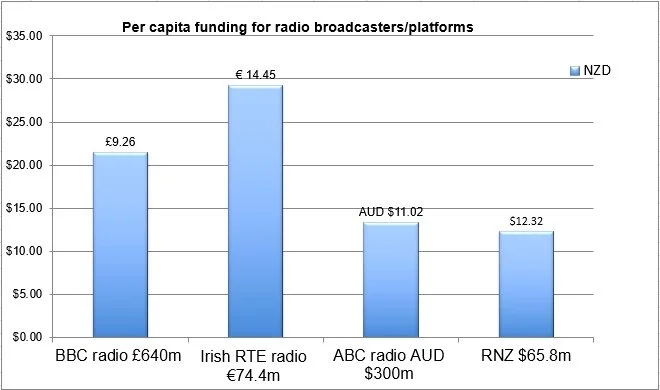
Fortunately, Radio New Zealand is better funded these days than under the Key government when its budget remained frozen at pre-2008 levels. The Ardern government increased RNZ funding so that we spend almost as much per capita as Australians on ABC radio (see graph).
But healthy funding could easily be lost again with a government that thinks commercial radio is all we need. The Luxon government reduced RNZ funding and there is nothing stopping it going much further. Especially if RNZ was put into the hands of ACT or NZ First, the leaders of which have declared a particular dislike to our most trusted news media organisation.
It is vitally important to our democracy that RNZ remains adequately funded. We need RNZ to have fully staffed newsrooms, a comprehensive news website, a continued focus on independence from politics and politicians.
We’d like to see RNZ develop new specialist stations for niche audiences such as South Islanders, Aucklanders, farmers, sports fans, immigrants, jazz fans, country music fans and so on. These ideas might seem ambitious but overseas the BBC, ABC and RTE provide many niche radio stations to meet the diverse needs of listeners.
Most importantly, RNZ needs ring-fenced government funding so that future governments cannot lay siege to our most trusted newsmedia by starving it of funding. Also we’d like to RNZ board appointed by anyone other than a government minister. The ability for an irresponsible populist to stack the RNZ board with political appointments is too easy, and please don’t say it will never happen.
It is vital that politicians cannot influence the news-reporting capability of an 'unfriendly' news outlet.
Public interest journalism
Let’s not follow the US model
If you want to know what happens to a nation’s politics without strong non-commercial news media, you need look no further than the United States. The US has never had a strong public interest news organisation like the BBC or CBC in Canada.
PBS and NBR are very small and everything else is commercial. From CNN to Fox News and beyond, it is all focussed entirely on maximising audiences. That’s one reason why politicians in the US have become more lambastic, more extreme, more attention-grabbing - because the media report it heavily. Reporters may despise Trump but they will always report what he says because it gets clicks.
If the US had a strong non-commercial public interest news organisation at the centre of its newsmedia would the Republican Tea Party movement have flourished? Would Alex Jones and other conspiracy peddlers have been so successful and influential? Would Trump have been elected twice?
The one thing that makes news media in the US different to the rest of the world is the lack of a strong non-commercial public interest news media. It’s not that bold a call to say that this long-term deficit has over several decades created the current madness we see today.
We don’t want that in New Zealand. But we may slowly be going down that path, with extreme right-wing news organisations springing up, and concerning interests taking over some of our biggest news organisations.
We need more public interest journalism to temper and counter-balance the hyper-commercial, uber-sensational, tabloid news media.
The right to know
Public interest journalism is not left-wing journalism. It is reporting that is willing to challenge the government (Labour or National), willing to challenge businesses and local authorities without concern of losing their ad-spend, willing to stick its neck out for the sake of the audience.
Public interest journalism is also about meeting the interests of all New Zealanders. It is media coverage that represents the diverse demographics, interests and cultures of our beautiful country. It can include investigative journalism and positive community reports which is not always hugely lucrative. Quality public interest journalism is a right of every citizen, and not a privilege to be enjoyed only by those who can afford to pay.
The fourth estate
There’s a reason news media are called the ‘fourth estate’ after parliament, the executive and the judiciary. Public interest journalism is critical to a functioning democracy - to watch that the government is doing its job honestly, fairly and efficiently. It also benefits democracy by encouraging and facilitating civic discussion, participation in public life and providing a range of perspectives to contest ideas and inform citizens.
BPM recognises the essential role played by public media in serving the people with robust, independent and comprehensive news and current affairs. To this end, the BPM supports measures to enhance independent, public interest journalism through broadcasting and other media.
Sustainable funding
Who’s going to pay for all this then?
For many years, BPM has been proposing a levy as a simple, cost effective and sustainable way to fund public media in Aotearoa. Currently RNZ and NZ On Air are funded each year depending on the whims of the government, whether there is money to go around or whether there are cuts across the board. Both organisations struggle to get noticed against all the other big ticket costs that governments must budget for – education, health and tax cuts for landlords.
A levy moves the funding decision a little bit further away from politicians so that the funding can be more sustainable and cost-neutral for the taxpayer
This idea is not new. Levies already work well in many countries including France, Spain, Ireland, Estonia and Australia. In the UK Channel 4 was established with a levy on the ITV network. In fact broadcasters in NZ already pay levies to fund the Broadcasting Standards Authority and Radio Spectrum Management at MCH. As consumers we pay levies all the time without blinking on our power bill and our insurance bill. Businesses pay levies each time they file an annual return that funds the Financial Markets Authority. The Telecommunications Development Levy was established to help fund rural ultra fast broadband and mobile phone coverage. It required internet service providers like Vodafone to contribute some of the profits they make using infrastructure funded by the taxpayers. These small levies help us to painlessly fund the things we need, often the result of a market failure, without complaint.
There’s no doubt that can no longer rely on the market to provide the watchdog on our democracy, strengthen our culture and support social cohesion.